

Decision Brief
Claude Batch API or prompt caching? Start with the shape of the workload
Claude batches trade immediacy for lower request costs; prompt caching targets repeated prefixes. For small API teams, the choice starts with waiting time and input reuse—not the discount headline.
Published · Updated · Sources reviewed 2026-09-13
For: Small development teams deciding how to reduce a recurring Claude API workload’s cost.
Two different levers, not interchangeable products
The Message Batches API processes independent requests asynchronously at a 50% discount relative to standard API pricing. A batch can expire after 24 hours, so a lower price is not a promise of interactive response time. Results can arrive out of input order; associate them with the original request using custom_id. [batch]
Prompt caching reuses an exact input prefix. Claude’s documentation describes a default five-minute cache lifetime, refreshed by reuse, and an optional one-hour lifetime with different pricing. Cache eligibility and pricing depend on the model and configuration; a repeated topic is not necessarily an identical reusable prefix. [cache]
The SourceVane decision
SourceVane analysis: For an overnight classification job, waiting may be acceptable while result reconciliation is essential: design the result importer and retry handling before estimating savings. For an interactive assistant with a long, repeated instruction block, a reusable prefix is the more relevant starting point. Neither choice substitutes for checking output quality. [batch] [cache]
SourceVane analysis: The useful unit is cost per accepted result, not the cheapest nominal token rate. A request that expires, must be retried, or fails your task criteria can erase part of the apparent saving. This is an evaluation framework, not a measured savings claim for a particular application. [batch] [cache]
A pilot you can actually evaluate
Keep a small fixed set of representative inputs and a written acceptance rubric. Compare the existing workflow with one changed setting at a time. Record successful results, billed input and output, elapsed time and retries. For caching, distinguish a first write from a subsequent reuse. Save model identifiers and run dates alongside the results.
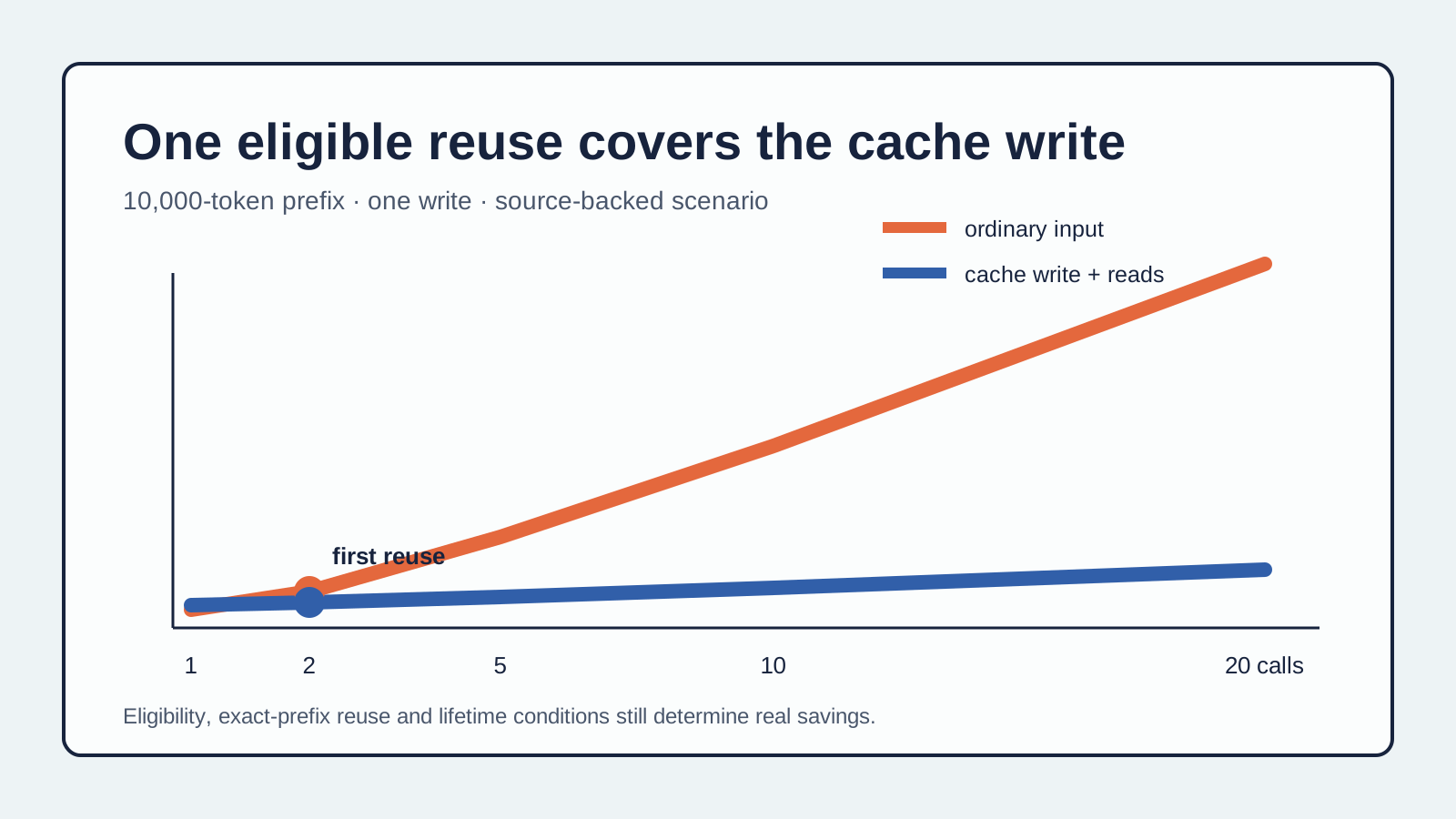
SourceVane analysis: Using the prices SourceVane checked for Claude Sonnet 5 on 2026-09-13, one 10,000-token cache write costs $0.025 and one eligible read costs $0.002; processing the same prefix normally costs $0.020 per call. The first eligible read after the write crosses the break-even point in that narrow scenario. This calculation does not establish that a real request will produce a cache hit. [cache] [pricing]
Limits
SourceVane has not run a paid API experiment for this guide. Actual savings depend on model choice, cache hits, output length and failed work. Consult the current model-specific pricing before budgeting; the examples above do not quote a universal cache discount.
Review the prompt-cache break-even study and downloadable data
Choose by constraint
- Independent background jobs can wait. Pilot batching with explicit request/result reconciliation.
- Interactive requests reuse a long identical prefix. Pilot caching and measure actual reuse rather than assuming every request hits.
- Inputs change substantially and results are needed immediately. Keep the standard workflow as the baseline; neither headline discount establishes a fit.
Sources
- Claude batch processing documentation — How the Message Batches API works; processing results
- Claude prompt caching documentation — How prompt caching works; cache limitations
- Claude Platform pricing — Claude Sonnet 5 standard and prompt-cache input rates, checked 2026-09-13
How this article was produced
SourceVane reviewed the linked documentation and separated reported facts from editorial interpretation. No hands-on benchmark was performed. External reader feedback has not yet been collected.
Revision history
2026-09-04 — Initial source-reviewed explanation. No hands-on benchmark performed.
2026-09-13 — Added a source-backed cache break-even scenario and linked reproducible data.